





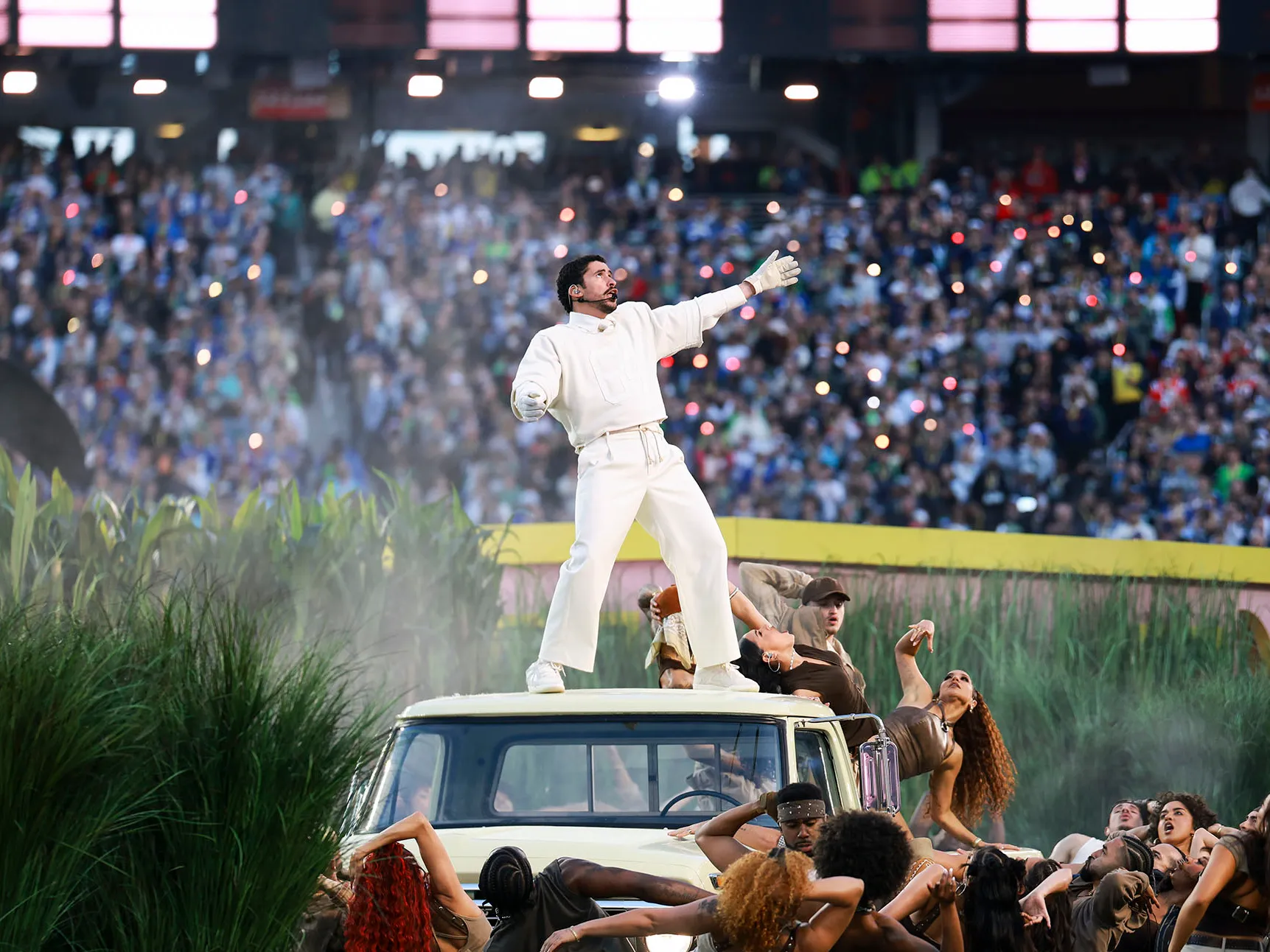
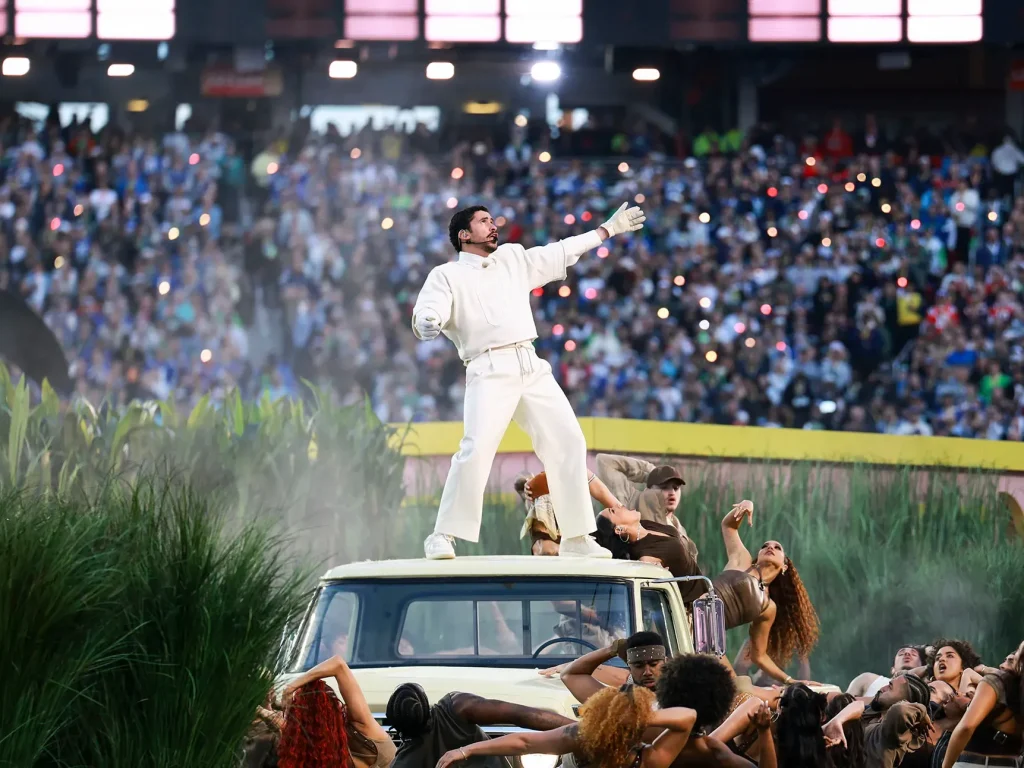
This Sunday, February 8, the Super Bowl of the NFL, the most important American football event of the year, was played. It is a tradition that during halftime there is a musical and choreographic spectacle, usually led by the biggest artists of the moment. Madonna, Coldplay, Lady Gaga, Kendrick Lamar, and even the legendary Michael Jackson are just some of the artists who have unleashed their creativity to captivate one of the most demanding audiences in the world. This year, it was Bad Bunny‘s turn.
Now everyone wants to be Latino
From the moment the name was announced, controversies began to arise. It was the first time in history that a Latin American solo artist headlined the Super Bowl main show. For many, it was a lack of respect for American traditions, as many viewers claimed not to understand the reggaetonero’s lyrics because they were in another language. However, the Puerto Rican artist is by far the most listened to artist worldwide, and in this era, decisions of this type are more guided by charts than by people’s feelings.
The show was almost entirely in Spanish. Bad Bunny performed a repertoire of his own songs that were very well-known to Latin Americans, but not so much to Americans. Throughout the concert, there were also references to other legends of Puerto Rican music, such as Daddy Yankee. In itself, it was a great vindication of Latin culture, or at least of what the American public considers Latin culture to be.
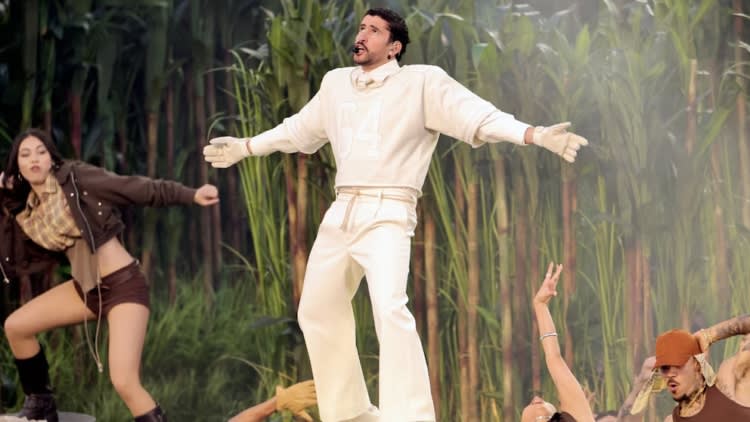
Bad Bunny took the stage with an impressive production and dozens of dancers
The players, mostly against
Poker players did not miss this opportunity to express their opinions on the matter, through the always controversial social network X.
Daniel Negreanu 
“I always watch the halftime show to share my expert opinion with you.
I like reggae and reggaeton, I’ve always listened to a bit since I was young. I don’t care if it’s in Spanish, English, Spanglish, it’s all about the beat and the rhythm. This was certainly ‘a show,’ with transitions and a story to tell, but I’m not good at speaking Spanish, nor is most of the audience, so I couldn’t follow the story very well. Cornfields, a barbershop, I think I get the connection. Also the little kid from Puerto Rico who just won a Grammy. ‘This is for you, kid, you too can live the Puerto Rican dream… in Los Angeles, like I did.’
As for the artist, I don’t think he’s exceptionally talented and he reminds me of boy bands. You put some good-looking people to dance and you have teenage girls screaming, and you don’t worry about their singing talent, it’s not relevant. You write some catchy songs and they sing them, almost like a Milli Vanilli style. Bad Bunny gives me that feeling, well put together, catchy music, he doesn’t need to sing well and auto-tune can make him sound halfway decent.
But I don’t see a real musical talent, like Justin Bieber, Elton John, Michael Jackson, Beyoncé, etc. There are many reggaeton artists who could have done exactly the same thing he did.
The addition of Lady Gaga, a true icon, seemed brilliant to me, as did the other guy whose name I don’t know, who could really sing, albeit in Spanish.
I believe the show shouldn’t be for young artists. To achieve icon status, you need to transcend generations and be around for 10 or 15 years. It was better than I expected and I’m glad they chose a less controversial path than they could have.
I imagine that in this modern era, they must choose artists who will attract the most views, targeting both those who love them and those who hate them, as they are the ones who will talk about it, whether good or bad, on podcasts and social media. I don’t think the goal is still to put on a show for everyone. We live in a different world now, where controversy sells, anger generates clicks, and division is the norm.
I’d like to go back to the days when Michael Jackson performed and the whole world agreed on how amazing he was. My prediction from here on out is that they will always choose an artist that some love and others hate. It’s a recipe that works.”
The Argentine Nacho Barbero 
“I’m Latino and this was by far the worst Super Bowl halftime show. What was that shit?”
One of the few players who seemed happy with Bad Bunny’s show was Sam Kiki 
Read also: Adrián Mateos Responds How Much Of The US$54 Million He Earned In Poker Is Real Profit — CodigoPoker
“The best halftime show I can remember,” wrote the American whale.
Latin vindication or cultural trivialization?
Bad Bunny’s objective was clear from the start. His show was aimed at Latinos, both those living in the United States and those watching from their home countries. That is why the artist took advantage of his moment in the spotlight to make constant references to Latin American culture. One of the scenes that generated the most comments was that of a child sleeping on a pile of chairs in the middle of the party, an image that any Latin American has seen at least once in their life at a family gathering.
When the Puerto Rican artist said “God Bless América,” he made it clear that he wasn’t just referring to the United States of America. Immediately after, people with flags from all over the continent entered the stage, with Puerto Rico’s flag at the forefront, as Bad Bunny named them, country by country.
Many questioned these types of messages, as it was a traditionally American event, located within the United States and with an almost entirely North American audience. However, there are political undertones that are difficult to ignore.
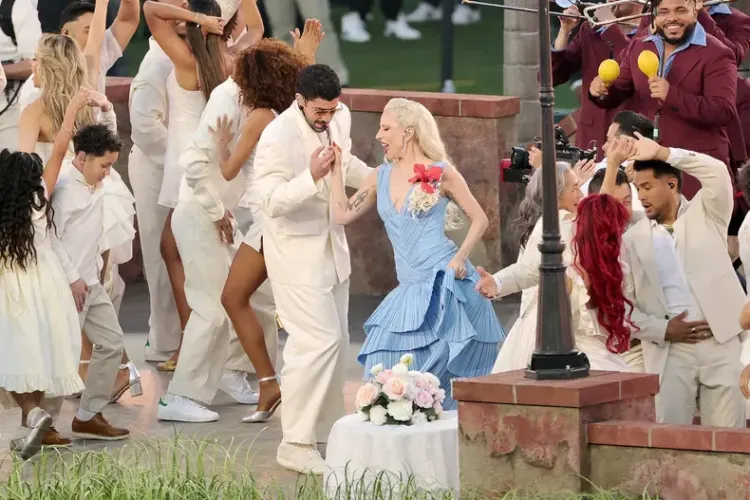
Lady Gaga was on stage with Bad Bunny as the American voice
Puerto Rico, the country Bad Bunny hails from, has been considered an Associated Free State of the United States since 1898. Since 1917, its inhabitants have been considered US citizens, although they do not have the right to vote for the president and lack representation in Congress.
In his latest album, Debí Tirar Más Fotos, the Puerto Rican artist makes constant references to this kind of “neo-colonialism” that his country has suffered for over a century. Songs like “Lo que pasó en Hawaii” express the desire of the Puerto Rican people to establish themselves as an independent nation, rejecting North American cultural invasion.
It seems that what the artist proposes is an invitation to reflection for the American audience itself. How can they say that a Puerto Rican show goes against American culture if they have annexed the island to the United States for over a hundred years? Are they Americans in bureaucracy, but not in culture? To what extent does Latin culture extend, and at what point does it become part of “Yankee culture”?
Beyond personal musical taste, Bad Bunny’s music poses a cultural and almost political dilemma, or at least his latest work does. On one hand, Latin American culture is vindicated, while on the other, that same culture is increasingly being absorbed by the United States. Can a man with American nationality lead the popular Latin American rebellion against North American colonialism, or is he merely another instrument to advance the absorption and, therefore, dissolution of the culture?
Read also: MTT Sports: Cuban Player Climbs To Top 10 In Global Rankings