









Poker has changed. And a lot. Not so many years ago, studying meant reviewing hand histories, discussing situations with other players, watching videos, and relying heavily on hours spent at the felt. Today, programs like PioSolver or GTO+ can analyze scenarios in seconds and tell us how often we should bet, call, fold, or bluff.
The GTO revolution is here to stay
Solvers have virtues that are hard to dispute. They don’t go on tilt, don’t feel fear when the pot becomes huge, and don’t call out of spite after a bad beat. Additionally, they help find mistakes that can go unnoticed for months: folding too much to river bets, incorrectly defending blinds, or building unbalanced 3-bet ranges.
So, why do we need experience? Because we face humans.
A solver, as explained in the column published on Highstakesdb, builds strategies assuming opponents also respond optimally. In a real game, that rarely happens. If someone folds too much to a continuation bet, it’s probably more profitable to exploit that than to maintain a perfectly balanced frequency. If another calls almost anything, perhaps the way is to forget certain bluffs and bet for much thinner value.
And then there are elements hard to put into an equation: tells, response times, conversations, emotional states, and dynamics that can change after a huge pot.
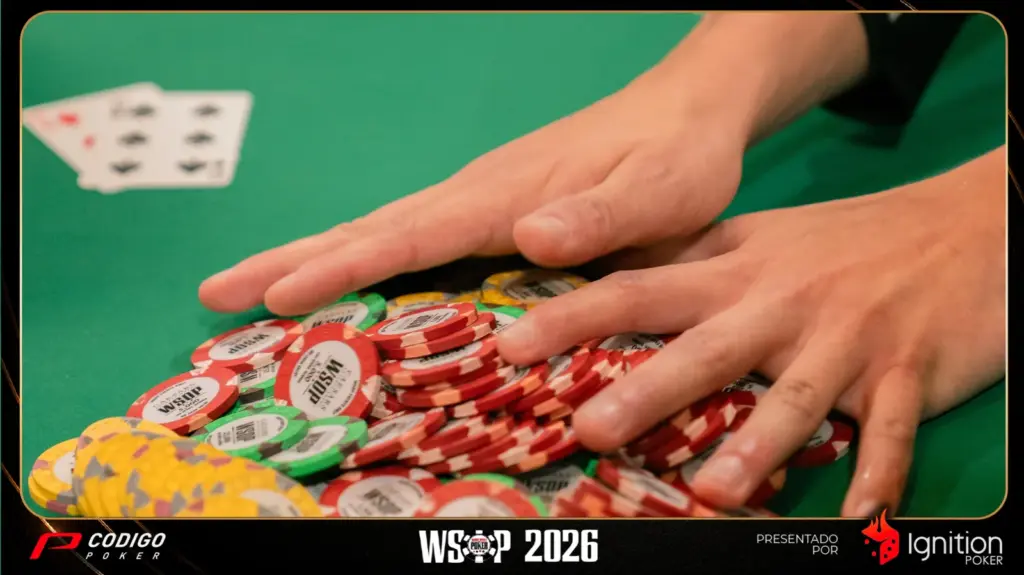
Sitting at a real table offers sensations, reads, and dynamics that are hardly replicable by a solver.
Read more The BSOP Florianópolis starts and it’s live on CodigoPoker! — CodigoPoker
Tournaments complicate the discussion even more
ICM, bubbles, payout jumps, and different stack depths can turn an apparently standard decision into a completely different problem.
That’s why the best professionals don’t seem to choose between computer and instinct. They use solvers to build a solid foundation and experience to know when to abandon it.
Maybe that’s the answer
The solver can teach you how a perfect opponent should play. Experience, on the other hand, allows you to discover how this opponent is playing, sitting across from you, right now.
So we leave the discussion open for the weekend: if you had to choose only one tool to improve your poker, would you stick with a thousand hours studying GTO or a thousand hours playing at the tables?
Read more Like a movie! A couple won four WSOP Circuit rings in the same series — CodigoPoker